
Not all hypertension is straightforward. While many patients present with consistently elevated readings in any setting, a significant proportion show a more complicated pattern — one that a clinic visit alone is fundamentally unable to reveal. 24 hour abpm has become the standard diagnostic tool for uncovering these hidden blood pressure phenotypes, and understanding it well is essential for any clinician involved in hypertension management.
The Limitations of a Single Blood Pressure Reading
Blood pressure is a dynamic physiological variable. It fluctuates continuously in response to physical activity, emotional state, temperature, time of day, posture, and dozens of other inputs. A single measurement taken at a fixed point in time captures none of that variability — it captures only what blood pressure happened to be doing at the moment the cuff inflated.
In the majority of cases, that measurement is a reasonable approximation of a person’s blood pressure status. But in a clinically important minority, it is significantly misleading. This is the core problem that 24-hour monitoring is designed to solve.
White Coat Hypertension: Elevated in the Clinic, Normal Everywhere Else

Definition and Prevalence
White coat hypertension is defined as persistently elevated blood pressure readings in a clinical setting alongside normal readings obtained outside that setting — confirmed by ambulatory or home monitoring. Current estimates suggest it affects 15–30% of patients who present with elevated office blood pressure, making it a highly prevalent phenomenon in hypertension clinics.
Why It Happens
The mechanism is primarily an autonomic response to the perceived stress of the clinical encounter. Even patients who are not subjectively anxious can experience a sympathetically mediated pressor response when their blood pressure is being formally assessed. This response is often unconscious and can persist even after multiple clinic visits.
Clinical Consequences of Misdiagnosis
A patient with white coat hypertension who is started on antihypertensive medication on the basis of office readings alone is being treated for a condition they do not have. The consequences include the direct side effect burden of the medication (dizziness, fatigue, electrolyte disturbance, and more), the indirect burden of long-term prescription costs, and the potential harm of inappropriate blood pressure lowering in patients whose true resting blood pressure is already within normal range.
24-hour ambulatory monitoring is the only reliable method for distinguishing white coat hypertension from genuine sustained hypertension in patients with elevated office readings.
Masked Hypertension: Normal in the Clinic, Elevated Everywhere Else
Definition and Prevalence
Masked hypertension is the clinical inverse of white coat hypertension: office blood pressure readings are within normal limits, but out-of-office readings — captured by ambulatory or home monitoring — reveal consistently elevated values. Prevalence estimates in the general population range from 10–15%.
Why It Matters
Masked hypertension carries a cardiovascular risk profile comparable to sustained hypertension. Patients with this condition are at elevated risk of left ventricular hypertrophy, atherosclerosis, and cardiovascular events, yet they are routinely reassured on the basis of normal office readings and sent home without treatment or follow-up. This is arguably the more dangerous of the two hidden phenotypes, because it is the one that tends to be missed entirely.
Risk Factors for Masked Hypertension
Several factors are associated with a higher likelihood of masked hypertension, including elevated-normal office readings, smoking, diabetes, chronic kidney disease, high physical activity without corresponding clinic readings, and high occupational stress. Clinicians managing patients with these characteristics should have a lower threshold for recommending ambulatory monitoring.
Nocturnal Hypertension and Non-Dipping
A third pattern that 24-hour monitoring uniquely captures is pure nocturnal hypertension: blood pressure that is normal during the day but elevated during sleep. This is distinct from masked hypertension and requires the overnight component of ambulatory monitoring to detect.
Related to this is the phenomenon of non-dipping. In healthy individuals, blood pressure falls by 10–20% during sleep in a pattern called nocturnal dipping. Patients who fail to show this dip — or who show a paradoxical rise in nocturnal blood pressure — face substantially higher rates of cardiovascular and renal complications. Non-dipping is strongly associated with secondary hypertension, obstructive sleep apnea, diabetes, and autonomic dysfunction.
Identifying non-dippers requires nighttime blood pressure data. It is not possible to detect this pattern from office readings alone.
How Device Choice Affects Diagnostic Accuracy
Accurate detection of white coat and masked hypertension depends on the quality and completeness of the 24-hour dataset. Devices that generate significant artifact, that fail to record during sleep, or that disturb patients enough to alter their physiological state during monitoring will produce less reliable results.
Patient comfort during the overnight period is particularly important. Companies like hingmed have addressed this with all-in-one devices such as the WBP-02A, which removes the rubber tube connecting cuff and recorder. This seemingly small design change has a real effect on sleep quality during monitoring — and consequently on the reliability of nighttime readings, which are central to dipping classification and nocturnal hypertension detection.
What the Guidelines Say
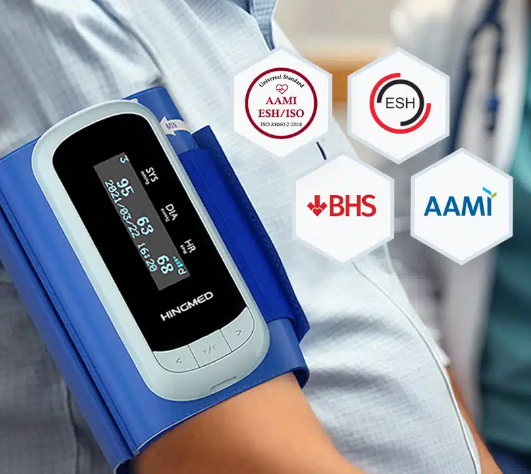
Both major international hypertension guidelines specifically address the use of ambulatory monitoring for phenotype detection:
- The 2018 ESC/ESH Guidelines recommend confirmation of white coat hypertension by ABPM or home blood pressure monitoring before initiating treatment in patients with grade 1 hypertension (office readings of 140–159/90–99 mmHg).
- NICE 2019 guidelines recommend ambulatory monitoring to confirm a diagnosis of hypertension in all adults with a clinic reading of 140/90 mmHg or above.
- Both guidelines highlight masked hypertension as an important clinical entity that requires out-of-office monitoring to identify, particularly in high-risk groups.
Frequently Asked Questions
Can white coat hypertension develop into true hypertension over time?
Yes. Several longitudinal studies have found that patients with white coat hypertension have a higher rate of progression to sustained hypertension than normotensive individuals. This means that even patients confirmed to have white coat hypertension deserve periodic follow-up, including repeat ambulatory monitoring.
How frequently should ABPM be repeated in patients with masked hypertension?
There is no universally agreed interval, but most guidelines suggest reassessment every 1–2 years in patients with confirmed masked hypertension, or sooner if new cardiovascular risk factors emerge or symptoms develop.
Is a single ABPM session enough to confirm a diagnosis?
For most patients, a single well-executed ABPM session is sufficient for initial diagnosis. In borderline cases, or where the session produced a lower-than-optimal number of valid readings, a repeat session may be indicated before making a treatment decision.
Conclusion
White coat hypertension, masked hypertension, and nocturnal non-dipping are not rare curiosities — they are common, clinically significant patterns that office-based measurement is structurally incapable of detecting. 24 hour abpm is the established solution to this diagnostic gap, and its integration into routine hypertension assessment is no longer optional for clinicians who wish to practise in line with current evidence and guidelines.
More Health Blogs