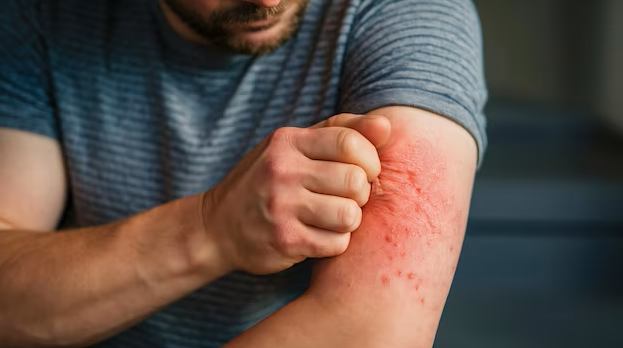
There’s a particular kind of exhaustion that comes with managing eczema long-term. Not just the physical stuff – the itch that wakes you at 2am, the raw patches that catch on clothing, the way summer heat turns into a kind of dread. It’s also the mental weight of never quite trusting your own skin. I wonder, every time it calms down, how long it’ll last this time.
Most people we speak to at our clinic who come for Ayurvedic treatment for Eczema have already been through the standard playbook. Steroid creams, antihistamines, hypoallergenic everything. And those things help – temporarily. But they don’t answer the question that actually matters: why does this keep happening?
That’s the question Ayurveda is built to answer.
First, let’s talk about what’s happening to the skin itself
Healthy skin has a structure that dermatologists sometimes describe as ‘brick and mortar.’ The skin cells are the bricks. The mortar is a complex mix of lipids – ceramides, fatty acids, cholesterol – that holds everything together and keeps moisture in, irritants out.
In people with eczema, this barrier is compromised at a structural level. There’s often a deficiency in a protein called filaggrin, which is responsible for binding those cells together. Without it, the mortar crumbles. And once it does, a sequence kicks off that’s almost impossible to interrupt from the outside:
- Water evaporates rapidly through the broken skin, leaving it dry and fragile
- Bacteria, particularly Staphylococcus aureus, colonise the exposed surface
- The immune system detects the invasion and floods the area with inflammatory chemicals
- The itch intensifies, scratching makes the barrier worse, and the whole cycle repeats
That last part, the itch-scratch cycle, is what makes eczema so uniquely maddening. Every scratch triggers more inflammation. More inflammation means more itch. You can’t think your way out of it, and no amount of discipline breaks a cycle that’s running at a biological level.
Topical steroids interrupt this loop, which is genuinely useful in a flare. But they don’t repair the barrier. They don’t address what’s driving the inflammation. And so when you stop using them, you’re back where you started – or sometimes worse.
Where it actually starts
Eczema is categorized clinically as a skin disease. But in Ayurvedic medicine – and increasingly in modern research – the skin is understood as a downstream indicator. What appears on the surface usually reflects something happening much deeper in the body.
Three patterns come up again and again in people with chronic eczema:
The gut connection
The relationship between gut health and skin health isn’t alternative medicine anymore – it’s well-documented in dermatology literature. When the gut lining is compromised (a state researchers sometimes call intestinal permeability), undigested proteins and bacterial byproducts can cross into the bloodstream. The body mounts an immune response. That response, over time, expresses itself through the skin. Many adults with stubborn eczema who address their gut health see significant skin improvement even before changing their skincare routine. That’s not coincidental.
Chemical overload
We live surrounded by synthetic compounds that skin simply wasn’t designed to handle. Surfactants in laundry detergent, parabens in moisturizers, synthetic fragrance in everything. Each of these strips the skin’s natural oils and disrupts the microbiome that lives on the skin’s surface. For someone whose barrier is already genetically compromised, this isn’t minor. It can be the difference between manageable and miserable.
Chronic stress
The brain and the skin develop from the same embryonic tissue. This isn’t a metaphor – they are literally connected in ways that have measurable physiological effects. Cortisol is anti-inflammatory when the body releases it in short bursts. But when stress becomes constant, the body becomes resistant to its own anti-inflammatory signals. The result is runaway inflammation that has nowhere to go except, eventually, the skin. Eczema that flares reliably during periods of stress isn’t in your head. It’s your nervous system talking to your immune system in the only language it has left.
What Ayurveda sees when it looks at eczema
In classical Ayurvedic texts, the condition closest to eczema is called Vicharchika – a type of skin disease classified under Kushtha Roga. But the Ayurvedic understanding goes beyond the skin into what’s producing the problem.
Ayurveda works with three fundamental energies – Vata, Pitta, and Kapha – that govern physiological function. At the center of everything is Agni: the digestive fire. When Agni is weak, the body can’t fully process what it takes in. The residue this creates is called Ama – a kind of metabolic waste that accumulates in the tissues.
When Ama enters the Rakta Dhatu (the blood tissue), the body treats it like a foreign invader. It tries to push it out. The skin, as the body’s largest eliminatory organ, often becomes the exit point. The rash isn’t a malfunction. It’s the body doing exactly what it’s designed to do, with the wrong materials.
The character of the eczema – how it looks, where it appears, what makes it worse – tells a trained practitioner which dosha is most disturbed:
| Dosha | What the eczema looks like | What makes it worse |
| Pitta | Burning, red, bleeds easily, may ooze | Heat, summer, spicy food, anger |
| Kapha | Thick, heavy oozing, deep relentless itch | Cold and damp, slow digestion, dairy |
| Vata | Extremely dry, flaking, sandpaper texture | Cold and wind, anxiety, irregular routine |
How Ayurvedic treatment for eczema actually works
The word ‘treatment’ doesn’t quite capture it. It’s more accurate to say that Ayurveda creates the internal conditions where eczema stops being necessary.
That sounds abstract, so let’s be specific.
Step 1: clear what’s accumulated (Shodhana)
In cases where the condition has been present for years, or where it’s severe, you can’t simply layer new habits on top of a system that’s full. Panchakarma – Ayurveda’s deep detoxification process – addresses this directly. For Pitta-driven skin disorders specifically, Virechana (therapeutic purgation) is considered the most effective intervention. It clears excess heat and toxins from the liver and intestines, cooling the blood and reducing systemic inflammation. Patients consistently report that skin itch and redness decrease noticeably in the days following this process.
Step 2: rebuild with herbs (Shamana)
Once the system is cleared, specific plants are used to stabilise the doshas and support blood quality. Three herbs appear in almost every Ayurvedic eczema protocol:
• Neem – one of the most powerful blood purifiers in Ayurvedic medicine. Also antimicrobial, which matters given how commonly Staphylococcus colonises eczema-prone skin
• Manjistha – the primary herb for lymphatic drainage and blood cooling. It directly addresses the ‘heat in the blood’ that produces redness and inflammation
• Turmeric – curcumin, its active constituent, inhibits the NF-kB inflammatory pathway that’s chronically overactivated in eczema. This is now well-supported in pharmacological research
Step 3: change what goes in (Ahara)
Diet is where a lot of people stall. It’s one thing to take herbs; it’s another to actually change what you eat every day. But the clinical reality is that dietary triggers are often the main thing maintaining the inflammation.
Foods that consistently aggravate eczema across dosha types include nightshades (tomatoes, eggplant, peppers), fermented or soured foods, refined sugar, and anything excessively spicy or salty. These are reduced significantly or removed temporarily.
What replaces them: bitter greens like kale and dandelion, which actively support liver function and blood cooling; healthy fats like ghee and coconut oil, which nourish the skin from the inside; and cooling, high-water-content fruits like melon, pear, and cucumber.
Step 4: the nervous system piece
Given everything we said earlier about stress and the skin, this step isn’t optional. For patients who are past the active weeping phase, Abhyanga – daily self-massage with medicated oils like Nalpamaradi Thailam – serves a dual purpose. It repairs the barrier physically while simultaneously calming the vagus nerve, which governs the inflammatory response. Cooling breathwork practices (particularly Sheetali pranayama) are added for Pitta types to lower internal heat directly.
A note on working alongside your current treatment
If steroids are part of your current management, please don’t stop them abruptly on the basis of anything written here or anywhere else. Rebound flares from sudden steroid withdrawal can be serious and, in some cases, severe. The Ayurvedic approach isn’t about replacing what’s working – it’s about systematically addressing the reasons why you need it in the first place, so that dependence naturally reduces.
In practice, this means people often find themselves reaching for the steroid cream less frequently as the internal environment improves. Not because they were told to, but because the flares become less intense, less frequent, and easier to manage.
What to expect – and when
This is important to understand before starting: Ayurvedic treatment for Eczema addresses root causes, not symptoms. That means the timeline is different.
Symptomatic relief from a steroid cream can happen in days. Changing your gut microbiome, cooling your blood quality, rebuilding a compromised skin barrier from the inside – that takes weeks. Most people see meaningful, sustained improvement somewhere between four and twelve weeks, depending on how long the condition has been present and how consistently they’re following the protocol.
The thing that keeps most people going through that window is noticing that even before the skin is clear, the itch starts to change. It becomes less urgent. Less constant. The flares, when they do come, are shorter. That’s the signal that something real is happening underneath.
Long-term, the goal isn’t just clearer skin, it’s a body that doesn’t produce the conditions for eczema anymore. That’s a different outcome than ‘managed.’ And for most people who stay with it, it’s what they actually get.
One practical daily structure to start with
If you’re not sure where to begin, here’s a simple framework that bridges Ayurvedic principles with ordinary life:
• Morning: warm water with a squeeze of lime before anything else, gently wakes digestion without acid overload
• After every shower or bath: apply virgin coconut oil or a medicated Ayurvedic oil while the skin is still slightly damp, this is when the barrier absorbs most effectively
• With meals: a small amount of traditional buttermilk (Takra) spiced with cumin, or a quality probiotic, to support the gut-skin connection
• Evening: protect your sleep aggressively, skin repair is predominantly nocturnal. Ashwagandha or magnesium glycinate can help if sleep quality is poor
None of this is complicated. The difficulty is consistency over weeks, not understanding the steps.
Final thought
Eczema is one of those conditions that modern medicine treats well enough in the short term, but hasn’t really solved. The recurrence rates speak for themselves. What Ayurveda offers isn’t a miracle; it’s a more complete model of what’s actually happening.
The skin is always showing you something about the interior. When the blood is overburdened, when the gut is inflamed, when the nervous system is running hot, the skin tells you. The Ayurvedic treatment for eczema works by addressing all of that at once, systematically, over time.
It requires more patience than a cream. But the outcomes, when people commit to the process, tend to be lasting in a way that most eczema sufferers have stopped believing is possible for them. It is.